Unknown's avatar

Should It Stay or Should It Go?

My dad has two sayings related to possessions.

The first: “A place for everything, and everything in its place.” This one is nice in theory, but I’ve never been able to achieve anything loftier than “A place for most things, and most things in their place a lot of the time.” (I should probably mention that in order to cast a more favorable light on my habits, I’m conveniently including items such as the couch and refrigerator, which obligingly remain in their places at all times, in the tally of “most things”.)

The second saying: “Whatever you own owns you.” Dad would offer up this one up whenever we suggested getting a horse, for example, or buying our own camper instead of renting one. Or installing a pool. It seemed that horses, campers, and pools all demand a lot of work and time. If we acquired these things, they would own us. We’d labor on their behalf; we would be their slave. Their slave!

This second piece of wisdom works better for me. Its truth looms large whenever we’re faced with a home repair or car problem. And recently I spent several hours in the basement, rearranging the storage area and trying to determine which items were worth saving after a water leak had dampened them. “Whatever you own owns you,” a voice in my head mentioned. Yes, it was true. I was sweating over stuff we seldom or never used. This stuff owned me—or at least it had retained me for the afternoon.

In that moment, new motivation dawned for spring cleaning. Humming “You Don’t Own Me,” I surveyed the house and pondered which possessions were worth even moments of my service to them.

Old magazines? No.

This tower of rags? A few, yes; the rest, no.

The paint left behind by the previous homeowners? No.

The pipe-cleaner and bead necklace that Ace made for me? Yes.

The bundt pan? No.

The springform pan? Yes. Cheesecake, you know.

This shrieky little toy from a long-ago kids’ meal? Obviously a rhetorical question.

The note that Sonny wrote me in church last week? Yes.

The malfunctioning camera that could possibly be repaired? No.

The Hunger Walk shirt that I haven’t worn in years, even for yard work? No.

Decisions about small things were easy. Those about large things were more challenging. The TV? The extra electronic devices? Stored furniture, even though we like it? Well . . . no.

Meanwhile, what else could I emancipate myself from?

The embryonic grudge from yesterday’s misunderstanding.

Concern about what others think of me.

The avoidance of conflict, even potentially helpful conflict.

Unrealistic expectations of myself and others.

Impatience.

I don’t want these things to own me, either, even briefly. They are not worth my time and effort. Nor do I want them to shape who I am and infect my relationships. So although tossing them out won’t be as easy as dropping that shrieky little toy into the trash can, it’s an effort worth owning—and owning me.

What things own you?

Unknown's avatar

Those Pesky Cats of Kilkenny

“There once were two cats of Kilkenny,
Each thought there was one cat too many,
So they fought and they fit,
And they scratched and they bit,
Till, excepting their nails
And the tips of their tails,
Instead of two cats, there weren’t any.”

When in our much younger years my sisters and I would fight/argue/vehemently discuss, my parents took up the habit of reciting this poem to us. It was their defense against hearing about whose right it was to invade someone else’s bedroom, for example, or who hadn’t done her share in cleaning the fish tank, or who poked whom and whether this was done on purpose. Eventually they decided to save some of their breath and began abbreviating their point by simply announcing into the air, “Oh, look, it’s the cats of Kilkenny.”

Cats of Kilkenny

Any success with shushing us with this method was due not to the fact that we internalized their warnings of destroying each other. It was because we didn’t want to listen to cat poetry when we were trying to determine which unlucky sister’s turn it was to sit in the middle seat of the car or exactly what qualified as hogging the bathroom. Meanwhile, I mentally added “say ‘Cats of Kilkenny’ at them” to the list of the hardships I vowed never to deliver to my own children someday, along with “force them to make their beds when they’re just going to sleep in them again anyway” and “refuse to serve sugary cereal for breakfast.”

Fast forward until last week. Sonny and Ace were engaging in constant and noisy disagreement over . . . well, almost anything. Whose turn it was to set the table. Who was hoarding the green marker for no reason. Whether the word pool could be said to rhyme with itself.

And then it happened. As I wandered past a heated discussion about who had neglected to close the door of the couch cushion fort, the immortal words of “Cats of Kilkenny” poured from my mouth as though with a life of their own.

Did they stop fighting? No.
Had I really expected them to? No.
Then why did I do it? I don’t know.

Fighting. It sets my teeth on edge. But sometimes amidst their howling onslaught, Sonny and Ace reach resolution. Sometimes they do eventually listen to each other. So maybe if they keep it up, they will become expert resolvers and listeners, cutting out the middleman that is their fighting.

Or maybe not. But this article  claims that sibling rivalry will eventually pay off with skills related to problem solving, regulating emotions, increased maturity and self-control.

Will this really happen? I don’t know.
If so, how long will it take before these new abilities kick in? I don’t know.

Just in case, though, next time Sonny and Ace fight, I might do something different. Perhaps instead of reciting “Cats of Kilkenny,” I will cheer them on: “Keep on practicing, boys. Try to keep it down, though, okay?”

Or maybe I’ll just claw my ears out. We shall see.

Now, if you’ll excuse me, I have to go compel my children to make their beds.

Unknown's avatar

On Finger Flippers and Connect Four

I point Ace’s face toward the sketchy pencil marks on the bathroom wall. “What is that?” I demand. He brightens. “A rhino!”

Sonny’s guitar practice sessions often involve more drama than guitar.

The person who is supposed to provide information for an article is not getting back to me.

It’s officially spring, but this morning’s wind chill was 2° F. This winter season will overlap with next winter; I just know it.

When I cook, I prefer to be unobstructed. This scenario almost never happens.

I’ve been on hold for 26 minutes, being periodically (seven times so far) instructed to stay on the line because my call is very important.

Yesterday, after I had to stop suddenly to avoid hitting another car in a parking lot, the driver of the car behind me leaned on the horn and prominently wagged her middle fingers (plural—what was she driving with, anyway; her feet?) at me. (“It’s okay, Mommy!” said Sonny, picking up on a few warning signs. “Just take deep breaths!” “And count backward from ten,” advised Ace. “Shall we do it together?”)

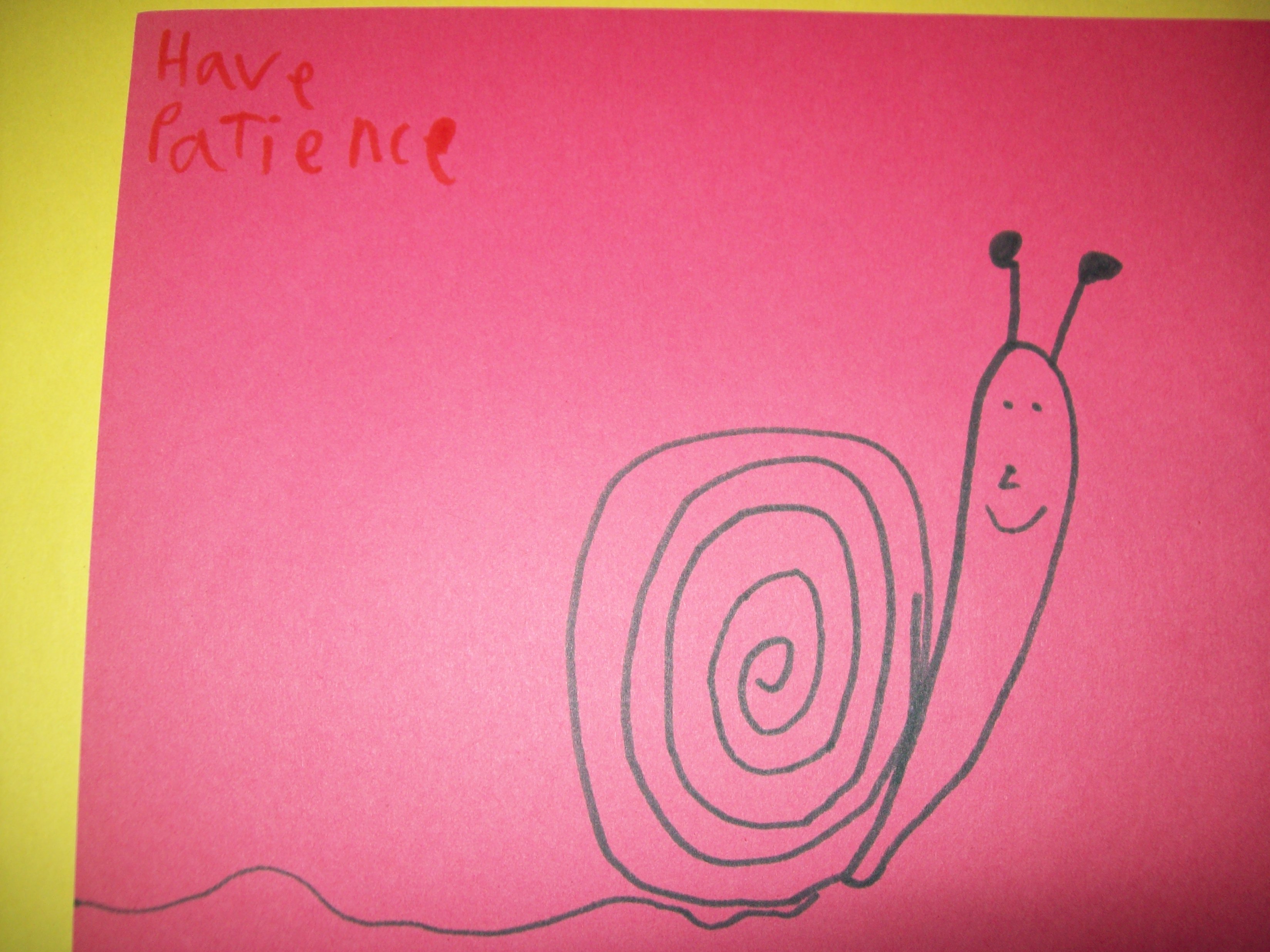
Patience. I need it—badly, sometimes. And when my (frequent) advice on practicing it is handed back to me, it suddenly seems not quite as easy as all that.

But meanwhile . . .

J is neat and organized, but IImage? Not so much. The state of the house usually reflects my habits.

An hour has passed since I told Sonny that I’d play Connect Four with him in a few minutes.

Occasionally Ace confesses that it upsets him when I raise my voice, and I promise to try not to do that anymore. But I keep doing it.

The bulletin board that Sonny and Ace are waiting to have hung on their bedroom has been leaning against the wall for about three weeks.

I have put off responding to a certain e-mail.

My resolution to be cheerful and lighthearted early as the boys get ready for school has not yet come to complete fruition. (Do cheerfully worded comments count as cheerful if they are delivered through gritted teeth?)

Patience. I demand it of others. Sometimes acknowledging this is my fastest route to offering patience to others.

“Love is patient,” says 1 Corinthians 13, and of course this is true. Why is it so hard to be patient to people we love?

“Patience is a virtue,” says common wisdom, and of course this is true. Why does proving ourselves to Crazed  Finger-Flipping Parking Lot Driver sometimes seem more appealing than virtue?

“Though patience be a tired mare, yet she will plod,” says William Shakespeare, via Nym in Henry V. Why is patience so tired? I don’t know. She’s lazy? She’s overworked? She’s underfed?  What matters is that she plods on regardless.

Patience: may she plod on beside you this week, both coming and going.

Unknown's avatar

Don’t Just Ask

Image

It’s rumored on the Internet that the average four-year-old asks 437 questions per day. I have a four-year-old, and that number seemed low to me, so I decided to count for myself. The other day as we pulled out of the garage, I took note of the time and started counting.

Why do pigs eat slop?

How does coldness turn water into ice?

Can we get an iguana?

Why not?

Does heaven have air?

Do harpoon makers make small harpoons for kids?

What are those red things on top of chickens’ heads and under their chins for?

Why does the word carpet have a car and a pet in it?

Are there bilge ducks, too, or just bilge rats?

Can God see inside and outside buildings at the same time?

How do T. Rex’s tails help them balance?

Thirteen minutes and 27 questions later we had arrived at our destination. I’ll let you do the math on that one, but it’s probably safe to say that at that, yes, he probably asks 437 questions a day.

And he expects an answer—a satisfying one—to each one.  He relentlessly hounds whomever he is questioning until one is delivered. “Well, can you find out? I need to know! Can we ask an expert?”

This little experiment made me wonder: Do adults have as many questions as four-year-olds? For the rest of the day I was keenly aware of my own questions—mostly unvoiced, but questions nonetheless.

Where did I put the field trip permission slip?

Why can I remember the lyrics to the songs from my fourth-grade musical (“It isn’t hot in the furnace, man, that furnace is cool, cool, cool!”) but not where I put the field trip permission slip?

Why don’t Honest Kids drink pouches have a hole for the straw?

Whose turn is it to set the table?

Did the words “Please take your sock off the toilet flusher” really just leave my mouth?

What is a more helpful response to someone’s crisis than “Let me know if I can do anything”?

How can I best help my kids learn gratitude?

Where is the unceasing public outrage for human trafficking?

Why does mercy triumphing over judgment look like? And why does mercy too often unsettle us more than judgment does?

Evidently I have just as many questions as my four-year-old. The difference: he pursues answers even to the trivial ones, and I too seldom pursue answers even to the non-trivial ones. They are transitory, too quickly fading away as I turn my attention to less important matters.

That’s not good.

What important questions do you have?

Let’s go find some answers.

Unknown's avatar

Just a Minute

Image

“You marked the minutes,” the old man said. “But did you use them wisely? To be still? To be grateful? To lift and be lifted?” —The Timekeeper by Mitch Albom

———————————————————————————

Recently my day began at 4:48 in the morning, at which time a four-year-old climbed into my bed with his ant farm, usurped my pillow, and cheerfully sang “Five Little Snowmen Fat. Every verse. I marked the minutes—all 72 of them until it was officially time to get up. I’m sorry, but it was 4:48—4:48 in the morning (or have I mentioned that?)—and that is too early to start the day. (Similarly, “all day” is too long to have “Five Little Snowmen Fat” stuck in one’s head.)

. . . . .

This past weekend my parents offered to host Sonny and Ace overnight. Looking forward to the break, on the designated morning I marked the minutes until J and I dropped them off. And as soon as we did, I marked the minutes until they returned. (Funny how that works, isn’t it?)

. . . . .

We often have trouble getting out the door. It’s time to leave, or it was time to leave seven minutes ago, and there we are, stalled in the mud room. One child can’t find his left shoe. The other can find both of his but wants to see if he can put them on using only one hand. (He can’t, as it turns out.) I mark the minutes, because we are going to be late. And when we finally get into the van, I realize I have forgotten something and must go back inside to get it. More minutes marked.

. . . . .

This historic polar vortex has put us under house arrest this winter. Repeatedly, as though we were repeat offenders of . . . something. Not sure what. The shine of snow days has worn off, and we are cold, and we are all marking the minutes until spring. Shoo, winter, shoo.

. . . . .

I signed up for the Festival of Faith and Writing this year. I can hardly wait, and yes, I’m marking the minutes until it’s time. And when it’s finally Festival time, I will mark the minutes carefully to squeeze every possible drop from the schedule.

. . . . .

Marking the minutes: check. No problem.

But using minutes to be still, to be grateful, to lift and be lifted?  Too often a problem, at least for me.

It’s easy to come up with theories on how to do these things. Successfully practicing these theories, though, is a little different. That takes effort and spending minutes.

I could list the things that help me to be still, to be grateful, to lift and be lifted, but your list is probably different than mine. So.

What helps you be still?

For what are you grateful?

Whom can you lift, and how?

How can you allow yourself to be lifted?

Those things are well worth our minutes. Let’s do them.

Unknown's avatar

Post-Valentine’s Day Love

Image

“When God gave me to you, did he say, ‘Will you love him?’”—Sonny, at age 3

Valentine’s Day, that holiday marked by special gestures such as flowers, candy, cards, dinners out, is over. Valentine’s Day, that holiday unobserved—even scorned—by many (and they have their reasons), will not roll around for another 363 days.

Any day that celebrates love—be it romantic love or love for children, siblings, parents, friends—is worthwhile. Who can argue with love? Who can argue with roses? Who can argue with boxes of chocolate (which are now being clearanced at your nearest pharmacy, so don’t just sit there!). But Valentine’s Day gestures doesn’t compare to showing love the rest of the year in ways unscripted by Hallmark.

For example: We love our children. We love them when they’re loveable and when they’re unloveable. When they’re drawing us pictures, when they’re snuggling to read a book, when they’re doing their chores, when they’re helping their brother, when they’re playing superheroes, when they’re singing in the bathtub. When they’re trashing the house, when they’re refusing to do their chores, when they’re tormenting their brother, when they’re enthusiastically bailing bathwater onto the floor.

But sometimes, I suspect, despite our best efforts, they might not always feel very loved. Maybe we sometimes forget to show love (or are too irritated to do so; see bathwater example), or we show it in ways that they don’t feel.

So, I asked Sonny and Ace and some of their contemporaries (via their parents) what makes them feel loved. Here is what they said:

When you lie down and rest with me.

Going out for lunch with just Daddy.

Getting hugs and kisses.

When you tell me you love me.

When you listen to me.

When you ask me what I think.

When you build things with me.

Snuggling.

Playing Candyland with me.

Notes in my lunchbox.

Laughing together.

Walking the dog with me so I don’t have to go alone.

Getting mail from Grandpa and Grandma.

When you notice I did a good job.

When people say thank you.

Much as they love Disneyland and electronics and staying up late and toys (and lots of them), none of these kids associated those things with feeling loved. They just want a little time, a little attention, a little affirmation, a little sharing of interests. A little grace. Then they will feel loved.

After all, Captain von Trapp loved his children, but they didn’t figure that out until he sang with them.

Adults are no different. Spouses, siblings, parents, grandparents, friends, neighbors—what makes them feel loved? A little time, a little attention, a little affirmation, a little sharing of interests. A little grace.

What does this look like? Depending on the recipient, maybe a phone call. Maybe a chore taken off their hands. Being listened to. A note. A visit. A sincere compliment. A favorite meal. Permission to be themselves. Praise or appreciation instead of criticism. A walk together. Going out for coffee. A hug.

See? You don’t even have to buy any roses or any chocolates (clearanced or otherwise).

So Happy Non-Valentine’s Days, all 363 of them. Don’t forget to celebrate.

Unknown's avatar

Snow Days

It’s winter. It’s cold. The snowfalls are tying records set in 1936. What has this meant? Snow days. Lots of them.

Early-morning announcements thereof arrive almost simultaneously via text message, robocall, e-mail, school Facebook page, news station Web page, and, if anyone cares to take the time to watch, TV. Such was the case again a few days ago as another snow day dawned—the seventh this winter, if anyone’s counting (which, judging by Facebook comments, many people are).

The previous week was a two-day school week. On Wednesday, the third consecutive snow day, the wind chill was (still) -20° F so it was (still) too cold to play outside. Sonny and Ace had abandoned their massive blanket fort in the living room. They had painted all the pictures they cared to paint. They had practically worn out their Legos. We had already completed the Facebook-recommended snow-day activities of making snow ice cream and tossing boiling water into the frigid air to form an instant cloud.

They just wanted to go somewhere.

In a last-ditch attempt to resist the siren song of Netflix for a few more hours, I filled a large plastic bin with snow and dragged it into the basement. Look, boys! You can drive your little cars in it, you can use your little bulldozers to make snow piles, you can craft tiny snowmen! All in the house! Thank you, Pinterest! I crept upstairs in search of solitude. When I checked a few minutes later, Sonny and Ace were having a snowball fight. In the house. Why had I not seen that coming?

(On went Netflix.)

Back in ye olde days, before text messages or WiFi (or Netflix), we learned of snow days the old-fashioned way: by peering at the list of school closings inching across the bottom of our 13-inch TV. Often we’d have one eye on the TV and one eye out the window to make sure the bus wasn’t coming. Alas, sometimes the bus was in fact coming, but sometimes the TV gave up the goods, ushering in a day of freedom.

My mom would make play dough in three colors, one for each of us. My sisters and I played Monopoly—one game lasted at least three days—and assembled jigsaw puzzles. We sewed muumuus for our Barbie dolls. (What? They’re easy to sew.) We shoveled snow and made snowmen families with my dad, who would pelt snow balls at us as soon as our backs were turned.

We poured maple syrup over snow to make candy à la Mary and Laura Ingalls’ Christmas preparations. (It totally did not work.)

We cross-country skied to Grandma and Grandpa’s house. Sometimes they’d join us to ski in the woods. Or play Boggle with us. Or consume tea and cookies.

When I was in second grade my older sister and I were snowed in at our aunt and uncle’s house. We spent the next day or two roller-skating with our cousins in the basement with our new Christmas metal clamp-on skates, visiting the sickly newborn calf that my uncle had bedded down in a corner for warmth and to keep a closer eye on. We were sad when it died during the night.

Did my parents get fed up when we had an overabundance of snow days? Probably. Do I remember them grumbling? No way. Maybe they were remembering their own snow days.

My dad’s family fortuitously shared a party line with one of his schoolteachers, who lived on a nearby farm.  When the teacher’s  distinctive ring rang on snowy mornings Dad always just knew it was the principal calling her to declare a snow day. One way to find out for sure, of course: listen in. Once in his excitement he neglected to hang up before cheering. (My grandma was mortified, as listening in on a party line was to be done very discreetly.)

My mom, unblessed by any teachers who shared the party line, relied on the radio for snow-day news.  The announcer would plod through the school names, taking too-frequent breaks for commercials. This took forever, but when she heard her school’s name she could never quite believe it and stood there for another round just to make sure. Then: snow-day fun. She would sled near the barn with the neighbor kids and ice skate on old, borrowed skates. She’d play Monopoly and cards with her siblings. She and my grandma would comb through Better Homes and Gardens and McCall’s for cookie recipes and craft ideas.

Did my grandparents get fed up when their kids had too many snow days? Maybe. Did they say so? I am sure they did not.

My grandma recently told of the winter of  ’36, that winter whose records are now being tied, when she was turning 11. The snowbanks reached the telephone wires. Her family was snowbound for 30 days. “Snowbound” meant “not able to get the car to town.” No grocery store runs for them, but that was okay, because they had shelves full of canned meat and vegetables, cows full of milk, and chickens full of chicken and eggs.

So how did she spend her snow days? She didn’t have them. She and her sisters walked—well, waded—across to their country school, as did the other students and the teacher. She didn’t mind. Ever the extrovert, she was glad to go to school. “We wouldn’t have gotten out otherwise,” she said. “Except that one Sunday when my dad hitched up the sleigh and horses and we went to visit our grandparents. They lived about five miles away.” Her voice brightened at the memory. “It was so good to get out and go somewhere!”

And now it’s 78 years later. Wading across the fields and hitching up sleighs seems so quaint. As do party lines and McCall’s magazine. As do clamp-on skates.  I wonder what will seem quaint about the snow days of 2014 a generation or two from now. Netflix, maybe? Facebook announcements? Will there even be snow days, or will we have found a way to overcome them?

Enjoy this memorable winter—snow days and all.

Unknown's avatar

Clutter and Peace

Clutter. It’s the bane of my desk. And kitchen. And hall. And minivan. And purse.

School papers, receipts, bits of modeling clay, socks (mateless and otherwise), wrappers, notes, crackers, colorful pipe cleaners, jars, oatmeal canisters, coupons. This morning I even found a banana in my purse.

You get the idea.

Occasionally something (such as a banana in my purse) tells me that the clutter is a tad out of control, and in a burst of optimism (or denial; you decide) I determine that it would take but a  little effort to eradicate it. My attempts look something like this:

I carefully sort through the pile of junk mail, keeping a couple flyers and recycling the rest.  Sonny and Ace follow my instructions to transfer any clothes that are lying around to the laundry room.

Next up: recycling. Out go the notes, receipts, most of the junk mail, and oatmeal canister. Out goes the months-old cardstock “armor of God” craft from VBS.

Ahhh, looks better already.

J comes in with the mail. He starts a new pile of flyers.

I schlepp a large shopping bag through the house, filling it with various and sundry items. A broken robot.  Mateless socks. The infernal Superman book that I can’t stand to read even one more time. An outgrown  shirt. The monkey puzzle with a missing piece. I park the bag in the mudroom and, recognizing that anything destined for Goodwill is automatically pronounced a cherished favorite, cleverly conceal it with an old blue pillowcase.

Sonny comes inside and carefully sheds his wet socks, leaving them under the bench in the hall.

I collect a pile of magazines, make a mental note to bring them to the preschool, and stack them by the back door.

“Here comes suuuuuuuuuuuuper dinosaur rescuer guy!” Ace zooms past, sporting a cape fashioned from an old blue pillowcase. Meanwhile, burrowing noises from the mudroom. It’s Sonny: “Hey, this is my favorite shirt! And my favorite robot! And my favorite puzzle! Why is all this stuff in here? Can we read the Superman book?”

I read the Superman book through gritted teeth and follow the trail of puzzle pieces to The Bag, stuffing the rejects back into it.

Ace is dumpster diving. “Mom! You can’t throw away Sonny’s breastplate of righteousness!” (Well, no, not when you put it that way.) “And I can make an invention with this oatmeal box!” He marches into the kitchen, possessively clutching the oatmeal canister, and dumps it in the vicinity of the other craft materials.

Meanwhile, I reconsider getting rid of those magazines. I haven’t even read all of them yet . . .

It’s not tidying up; it’s Whac-a-Mole. Evidently I lose at decluttering.

So it also goes in my head. Last Sunday began the week of Advent that focuses on peace. I determined that it would take but a little effort to shed any mental clutter that obstructs peace.  But then:

I check an acquaintance’s CarePage, and the news is bleak.

The recently-cleaned house is suddenly not clean. At all.

I hear an ambulance stop nearby.

Why is he having stomach aches again?

I am worried about a friend.

Why is the dryer making that noise?

Did I say the wrong thing? Yes, I’m pretty sure I did.

I miss my grandpa.

I can’t sleep lately, so I am tired, so I am crabby.

My Christmas to-list is nagging at me.

And so on.

Some of these are not insignificant matters, but many are. And despite my resolve to shed this mental clutter, I can’t seem to do so. Even when one piece is quelled, another pops up.

Evidently I lose at achieving peace.

J turns on Handel’s Messiah. “And His name shall be called Wonderful Counselor, the mighty God, the everlasting Father, the Prince of Peace.”

I may lose at achieving peace, but that’s okay, because it’s not up to me.

May you find peace this season—clutter and all.

Unknown's avatar

Hope Is a Superpower

“Mommy, if you had a superpower, it would probably be a walrus superpower. Then you could break ice with your head!”

Two things here: First, what is it about me that suggests “walrus” to my four-year-old? (And please keep any inklings to yourself, because I really don’t want to know.) Second, as long as he’s doling out superpowers, why couldn’t he grant me a more practical one?

I began to mentally form a wish list of useful superpowers—none of which, you may notice, relate in any way to walruses.

  • The “prepare for Christmas in the blink of an eye” superpower.
  • The “beam laundry from the dryer to the closet” superpower.
  • The “instantly purge the house of clutter” superpower.
  • The “quell whining with one calmly spoken word” superpower.
  • The “inject everyone in the house with gusto for whatever I cook” superpower.
  • The “be astonishingly organized and never procrastinate” superpower.

Caught up in the very idea, I began to make frequent mention of my superpowers. I would use my superpowers to start the van! I would use my superpowers to make a  spreadsheet! I would use my superpowers to prepare lunch! Finally Ace, drained of patience, sighed. “Mommy. Mommy. You don’t need superpowers to do those things. You just use your regular powers.”

Oh.

Right.

Lunch-making would be a waste of a superpower, wouldn’t it?  As would everything on my wish list (with the possible exception of that whining one). All they take is regular powers and some extra effort.

So, what superpower would I actually choose, given a chance?

  • The ability to assuage the pain of grieving friends.
  • The ability to ease the holidays for those whose hearts have been broken.
  • The ability to console those whose outlook is bleak.

And so on.

It’s Advent, the season of spiritual preparation for Christmas, the time of waiting for the coming of Christ. This first week of Advent has focused on hope.  Unlike the word wish, hope indicates possibility and expectation. As Kathleen Norris wrote, “Hope has an astonishing resilience and strength. Its very persistence in our hearts indicates that it is not a tonic for wishful thinkers but the ground on which realists stand ” (Acedia & Me: A Marriage, Monks, and a Writer’s Life).

We lack the superpower to magically exterminate others’ pain, but we can use our regular powers to chisel away at it until hope begins to glimmer and gives them ground on which to stand. We can use our regular powers to relay a memory of the loved one for whom they are grieving. To bring them a meal. To pat a shoulder. To send a note. To sit in silence with them. To babysit their kids. To invite them to our home. To send a comforting poem or passage or song. To take them on an outing.

Use your regular powers to clear their path for hope. When one has hope, one can go on.

May you have hope, and offer hope, this season.

Unknown's avatar

Do I Hear School Bells?

It’s 8:30 in the morning.

Sonny is grumbly because his brother keeps calling him Howard, because I haven’t let him watch TV in about seventeen years, and because his hawk paper airplane has a bent nose.

Ace is grumbly because I keep forgetting to address him as Diego, because I hung up the phone before he had a chance to talk to my parents (despite declining the opportunity before I hung up), and because he has to do everything around here.

The toxic combination of boredom and back-to-school jitters is compelling Sonny and Ace to trot out torments that only siblings can deliver well: copying each other (“He’s copying me, Mom!” “He’s coppppying me, Mommm!”), pretending to drink from the other’s cup,  and . . . wait for it . . . pointing at each other.  Darkly threatening to send each other to jail, to JAIL! Feigning ignorance (and innocence) over the whereabouts of his brother’s lost toy.

Constantly.

School starts on Tuesday, and that’s none too soon. We are sipping at the dregs of summer vacation, and these people need somewhere to go.

Sonny will be starting kindergarten. Over the last few weeks he’s dwelt on various concerns: the possibility of bullies, not knowing everyone in his class, wishing he didn’t have to be away from home all day. But yesterday he told a cashier that his new teacher smiles all the time, and he ended last night’s bedtime prayer with “and thank you that school starts soon.” Ahhh, he’s ready. Good.

Ace will be starting preschool. He is concerned because he likes alone time, which is scarce at preschool. He is nervous because he doesn’t know many of the other kids. But he also remembers being sad when he was two years old and went along to drop Sonny off at preschool. He’d wanted to stay, too. “When is it going to be my turn, Mommy?” he’d ask. And now, finally, it is his turn. Today he donned his new monkey backpack and marched proudly around the house. “Let’s pretend that I’m in preschool, Mommy,” he said. “Because . . . I AM in preschool!”  Ahhh, he’s ready. Good.

Am I ready? Ready for some solitude? Who, me? Sometimes the idea of completing a task, or a thought, without interruption has me almost salivating. Nobody lamenting that he accidentally bit his own hand while eating cheese, nobody knocking frantically on the bathroom door to report a cricket floating in the goldfish bowl, nobody arguing over whether to dig to China or build a fort, nobody boycotting the only pair of socks left in his drawer.

The other day Sonny and Ace spent a few hours at the neighbors’ house, and I amazed myself with how much I could accomplish when left to my own devices. I even seamlessly completed a phone conversation. The silence was golden.

Until it wasn’t. It became almost creepy. True, nobody was fighting. But also true: nobody was summoning me to the window to watch a deer or turkey. Nobody was calling me “Mommy-Tommy.” Nobody was painting pictures of volcanoes to hang on the fridge. Nobody was making his brother laugh helplessly, and nobody was playing pet store together. Nobody was issuing tickets for walking on the wrong side of the stairs.

Then Sonny and Ace returned home. They had enjoyed their time with the neighbors, and they were content . . . for about a minute, until one of them started pointing at the other. “He’s pointing at me, Mom!” (“He’s pooointing at me, Mom!”)

And so it went.

Am I ready for my kids to start school? Oh yes.

Will I miss them while they’re gone?

Absolutely.

Enjoy the school year, everyone.