Unknown's avatar

On Batman, Ancient Flutes, and Paint

Last Sunday Sonny ascended a stage at his first guitar recital and carefully plucked out the Batman theme song, an accomplishment weeks in the making. His serious expression transformed to one of obvious delight upon reaching the final note, confirming that the practice sessions had been worth it. “I felt kind of embarrassed,” he explained later, “but it was fun. I love to make music.”

So does nearly every child on the planet. Even those who do not beg for violin lessons at age 3 or sing with perfect pitch at age 4 or play concertos at age 5 love to make music. Sonny and Ace’s vocal repertoires are extensive and spirited, if slightly off-key and rife with mondegreens. They puff cheerfully on recorders and harmonicas and kazoos and train whistles, gifts from people who do not live in this house. And almost nothing is disqualified as a possible percussion instrument: oatmeal canisters, rubber bands, forks, books, tongues against teeth—you name it, and it can be an agent of whatever rhythm is currently occupying their imagination.

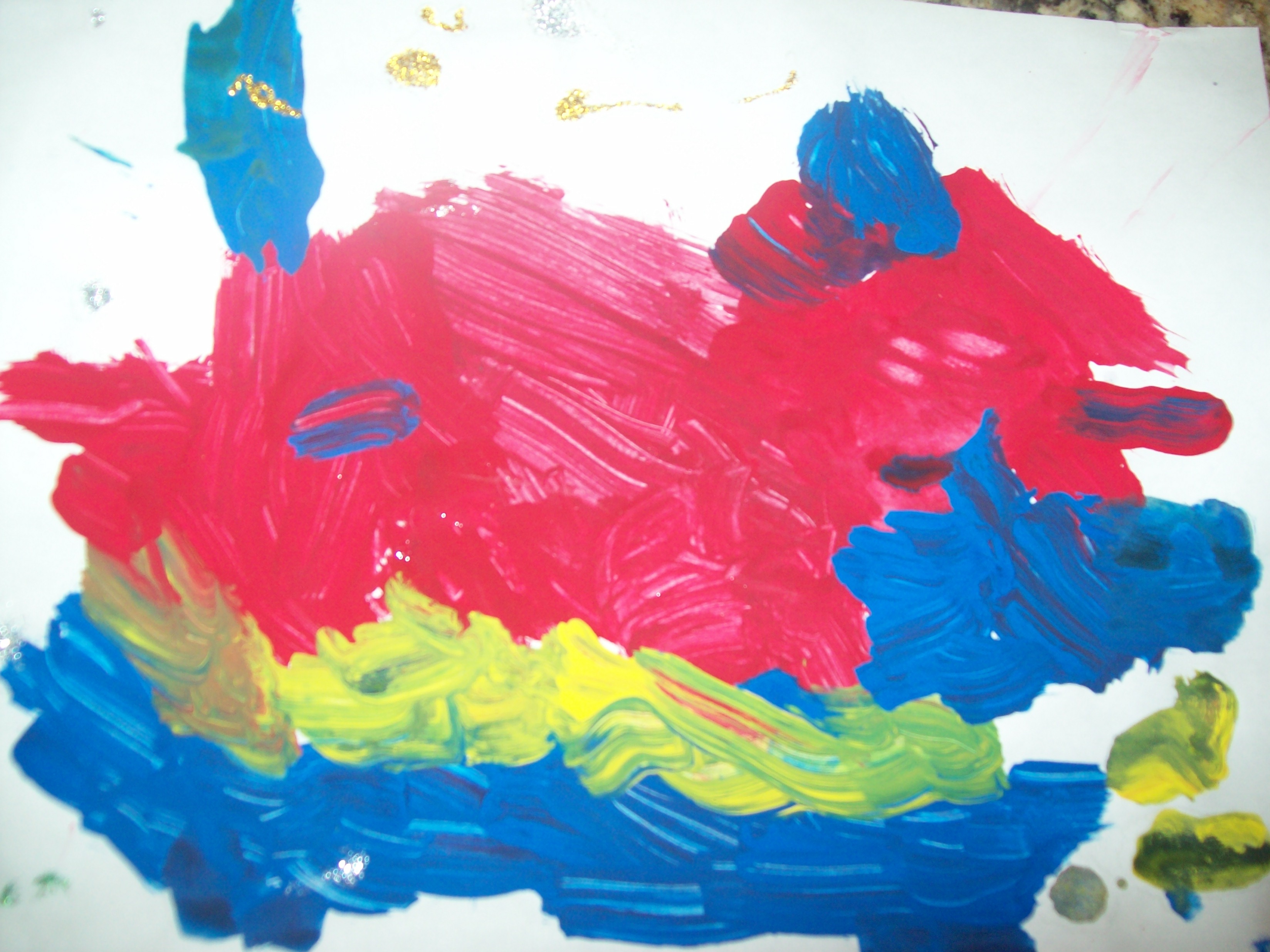
Paleolithic children, too, probably wandered the forests singing ancient versions of “Let It Go,” humming into auroch tusks, shaking pebbles in a seashell, tapping rhythms with a rock, whistling, crooning “Your toes are stinky, stinky, stinky” melodically into their brother’s ear. These children would get along well with today’s children. They’d squawk on a grass blade and become instant friends.

And then, perhaps inspired by blowing through a hollow stem, one of these children eventually fashioned a device solely for music-making purposes. Flutes made of vulture bone were discovered in Germany in 2009. The world’s oldest known instruments, they were made by an inventive music lover who lived 40,000 years ago.

Of course brilliant artistic minds existed in the Paleolithic age. Why wouldn’t they? But 40,000 years ago, surviving was a full-time endeavor. One might predict that this genius would remain latent in deference to gathering berries, chipping an axe blade out of stone, slaughtering the wild boar, fashioning crude clothing from animal skins. But it didn’t. Ancient musical instruments and cave drawings and even specially painted concert halls show that music prevailed despite life-threatening lifestyles. This probably would not have been the case were artistic expression not such a vital part of being human. It matters.

(I wonder what Paleolithic folk, who managed to create music and art even while evading the saber-tooth tiger, would think of their descendants, some of whom, despite their comparatively cushy lives, cannot rustle up the wherewithal to preserve music and art classes for schoolchildren. Not to digress here. Just wondering.)

Recognizing this essential nature of musical expression should help answer the lingering question, “Why can’t I go anywhere without hearing the nearest kid sing ‘Let It Go’?” It should help us better appreciate the enthusiastic strumming on the ukulele and the intrepid attempts to pick out “This Land Is Your Land” on the nearest piano and see beyond the challenges inherent in guitar practice with a six-year-old.

So play on, kids. Paint on. Sing on. Don’t ever let it go.

Unknown's avatar

Ten Things I Learned from My Mom

It’s Mother’s Day, that day when we officially focus on doing what we should do every day of the year—express gratitude for our mothers. And while I don’t say so nearly often enough, I am grateful for my mom. She’s taught me many things, some of which are spelled out below.

Of course this list could go on well beyond ten points; sorting out which messages to include proved more difficult than I expected. But then I decided to stop overthinking things (something my mom taught me) and just get on with it (something else she taught me), because this list doesn’t have to be perfect (see item # 9 below).

So here are, in no particular order, ten things I learned from my mom over the years.

1. It could be worse. Occasionally, or more often, my sisters and I would offer up to her various laments. She would sympathize as the situation warranted but then, when the time was right, point out that it would be worse. A scrape? At least we didn’t need stitches. A disappointing test score? At least we cared enough about our grades to be upset. An infected mosquito bite? At least it wasn’t a bee sting. The power went out? At least we usually had power at our house, unlike most of the world for most of time.

“It could be worse” is a lesson in perspective and in gratitude. Go ahead and nurse that wound for a little while, but know that it’s not as bad as it could be.

2. “Serviceable” is good enough. Occasionally our family would rent a camper for a summer trip—usually new large pop-ups, and once even a motor home, so when I learned my parents had actually purchased a camper for our upcoming vacation, I envisioned something similar to these. “Don’t get too excited,” my mom warned. “You haven’t seen it yet.” Well, I did get excited, because, really, how bad could it be?

Pretty bad, as it turns out. This camper was little more than a faded canvas tent over a flimsy metal base. This camper was ancient. This camper was rickety. This camper was homemade.

It was the most embarrassing camper in all the land.

But camp in it we did. While for a week my sisters and I slunk around the campgrounds, valiantly avoiding association with it, my mom was unfazed. “It’s just fine,” she maintained, confident in its utility. “It’s serviceable.”

It was, in fact. A family can still sleep and consume S’mores and play cards and sightsee while burdened with a decrepit RV. This vacation proved to be just as enjoyable as previous vacations. To this day we reminisce fondly about our trip in The Serviceable Camper ™, and to this day we all appreciate that something that can only be deemed “serviceable” is usually good enough.

3. Beautify your surroundings. Despite her contentment with serviceable accommodations, my mom cherishes beauty. So she plants flower gardens. She repaints the bathroom if she doesn’t like the way it looks. She garnishes food with a strawberry or a mint leaf or a swirl of frosting. (If you ever find an ice-cube-encased pansy in your lemonade at my parents’ house, fear not; pansies are edible.) She regularly turns on classical and sacred music. She sets the table with attractive napkins. As seamstress to all of our childhood clothes, she would adorn them with the prettiest possible buttons—sunflowers, strawberries, ladybugs.

She knows it’s within everyone to make the world a more beautiful place, so she does it.

4. Keep commitments. When I was about 10, a blizzard struck on a Saturday night and drifted our road shut. Did my mom plead “snowbound” and shrug off her obligation to play the organ at church the next morning? No. Instead, she contrived a solution that involved riding shotgun on my grandpa’s tractor.

If you think this is a woman who would allow her daughters shirk a commitment for any old reason, you would be wrong. There may have been a time when my sisters and I asked why we had to go to piano lessons while in the (non-contagious) recovery stages of virus, what would be the big deal about skipping catechism class once in a while, or why we couldn’t cancel our babysitting plans if a more appealing opportunity came along. If so, we quit asking, because we knew the answer: “You signed up for this,” she’d say. “It’s your job to be there. It’s not okay to let people down.”

5. One good reason trumps several flimsy reasons. “If you don’t want to do something,” she would advise, “offer a solid reason. The more reasons you give, the more it sounds like you’re making excuses.” So true, as was the unspoken but obvious message—if you have to offer several flimsy reasons, you probably don’t have even one good excuse, so examine your motives and act accordingly. (So why, exactly, can’t you paint the porch today?)

6. Know how to refresh yourself. One of my earliest memories involves my music-loving mom leaving the house for a dulcimer-making class. She loves hymns, so she attends hymn festivals. She enjoys sewing, so she sews doll clothes to give away. She travels to other states for Sacred Harp singings. She gardens. She laughs with her friends. She plans trips with my dad. She plays with her grandkids. And her mind and spirit are refreshed, and it shows.
7. Pick your battles. “Nobody will pay any attention to you if you try to get your way every time,” she’s point out; demonstrations abounded. She didn’t hound us over every little thing. She probably overlooked many matters that mattered more to her than she let on, but the standards that she did choose to enforce—among others: using proper grammar, avoiding profanity, participating in the church, and, of course, keeping commitments—highlighted her most cherished values.

8. Family stories matter. What is as captivating as a family story? I love the connection to my ancestors, both recent and distant. My mom is skilled at weaving her own memories and other bits of family history into conversation, sometimes to entertain, sometimes to make a point, sometimes to empathize, sometimes just because.
These stories have always fascinated me: her childhood fall from a moving vehicle; the car-radiator fire that my grandpa doused with their picnic lemonade; the relative who sent his regrets to her wedding because he wasn’t planning to make the five-mile trip into town that day; the notoriously bad cook whom other family members discouraged from contributing to potlucks; my great-grandma’s love of laughter. “You’re related to these people, you know,” she often adds. (Is there anything as humbling as the reminder that one shares DNA with a cantankerous great-great uncle who refused to observe Daylight Saving Time?)

9. Don’t pretend to be perfect. A non-spotless house would never prevent my mom from welcoming someone into it. Pride would never keep her from telling a self-deprecating but entertaining story—for example, that of when looked down while in a meeting only to discover that her shoes did not match. She has always matter-of-factly admitted mistakes, signaling that they are part of life and no cause for shame. “If pretended to be perfect all the time, you wouldn’t fool anyone anyway,” she once said.

10. Loved ones are a privilege, not a burden. I don’t have enough space to record all of the appropriate examples, ranging from dedication to elderly relatives to doting on grandkids, but this one speaks for itself. “Keep it simple,” as my mom would say, so on this final last point I will do just that.

I want to be like you, Mom. Happy Mother’s Day!

Unknown's avatar

Lies and Otherwise

Once upon a time, before I became a mom, I believed that I would never lie to my offspring. I believed this firmly, as firmly as I believed that a few exposures to any given food would guarantee that a child would learn to accept it—yea, even love it. Or that a toddler cleverly offered two acceptable choices (for example, that between the red pajamas or the striped ones) would dutifully pick one instead of, say, fleeing the room mightily protesting bedtime. Or that there was never any reason to bribe a child.

But parenthood divested me of these notions. My sons have yet to willingly consume black beans despite the beans’ frequent presence at our table. The “just give them a choice and they’ll automatically cooperate” tactic: futile. And if M&Ms are the key to persuading a four-year-old to swallow his medicine? So be it.

And despite my lofty aspirations, I have told Sonny and Ace things that aren’t true.

To wit:

“Close your eyes, and I’ll push a button so the car will fly over that overpass. It only works if you close your eyes, though.” (My dad used to feed this line to my sisters and me, and we turned out okay. Besides, it’s fun.)

“It’s against the law to whine on your mom’s birthday.” (Don’t judge me. It works.)

“If you walk around with food on your face, the bunnies will come and lick it off.” (Do I get credit for saying “bunnies” instead of “cheetahs”?)

“I guess I’m getting a cold.” (This on the terrible evening of the Sandy Hook massacre, when at bedtime Sonny asked me why my voice sounded funny. Even the simplest honest explanation—“I’m sad because some people got hurt”—would have spawned more questions whose answers I could not give.)

“I can tell always if you haven’t brushed your teeth.” (Regrettably, this is not true; my mom-skill set is incomplete. I can sometimes tell, though, and they need to brush their teeth, right?)

“You can’t have a cookie because the jackals came this morning and ate them all.” (Dinner was being dished up at the time. Ask a silly question, get a silly answer.)

“The class I took on how to be a mean mom recommended never saying yes to anything.” (Contrary to his contention, I don’t say no to everything. Just so we’re clear.)

So it’s true. I’ve lied to my kids. This should probably unsettle me more than it does.

But I am more unsettled by the truths I tell my children. Oh, I believe them wholeheartedly, and I want Sonny and Ace to believe them, too. But sometimes I worry that my actions will belie my words so that Sonny and Ace will regard as lies truths such as the following:

  • God loves everyone. He doesn’t hate anyone.
  • It’s okay, often even good, to make mistakes. You don’t have to pretend to be perfect.
  • Apologizing when you’re wrong is essential and is not a sign of weakness.
  • I will always be there for you, no matter what.
  • You are not better than anyone else, and no one else is better than you.
  • Comparing yourself to others is pointless.
  • Cutting down others is a sign of insecurity. Remember that when someone cuts you down; remember that when you are tempted to cut down someone else.
  • Money and contentment are unrelated.
  • Money and is unrelated to one’s worth.
  • It’s much easier to judge than to show mercy, but mercy ought to trump judgment.
  • You don’t have to be the best at something, or even good at something, in order to enjoy it.
  • If someone needs help and you can help them, it’s your job to do so.
  • You have many gifts.
  • Everybody deserves respect. This means you; this means everyone else.
  • God forgives, and so should you.
  • You are loved—not for what you do, what you’ve accomplished, what you own, what you say, or how you look. You are loved for being you. Nothing will change this.

How many inconsistencies between words and actions will it take before they reject these messages? How many slip-ups am I allowed?

It’s a lot easier to stop threatening my kids with fictional face-licking bunnies than it is to always demonstrate mercy or to always show respect to everyone or to brush off one’s own mistakes. But I’ll try to clean up my act on all counts.

And that’s no lie.


Unknown's avatar

Wisdom from Wooliam: My Messy Beautiful

“People generally see what they look for, and hear what they listen for.” – Judge Taylor in To Kill a Mockingbird by Harper Lee

—————————————-

Ace marched proudly from the preschool classroom, clutching the telltale yellow fabric bag. “I got Wooliam,” he announced, triumphantly displaying the bag and its occupant. “It’s my turn again!”

Wooliam is a stuffed lamb whom Ace and his classmates take turns hosting. This endearing little creature participates in the family’s activities and chronicles them in a journal entry. Naturally, the chosen four-year-old is thrilled over the opportunity to oversee him.

I must admit, though, that “thrilled” is not an apt description of my own reaction. While I applaud the spirit of this tradition and appreciate Wooliam’s importance to Ace, hosting duties can be . . . well, a wee bit burdensome. Not because Wooliam is a troublemaker (he’s not, although he has managed to get lost and throw us into a panic every single time he visits our house, starting with his first visit to Sonny over two years ago), but because of the journal. The journal is not only read to the preschool class but accompanies Wooliam on each visit for the host families to enjoy. Not to overthink things, but the temptation to manipulate an activity or two in order to make our family seem well-adjusted and not too tedious (or neglectful of Wooliam) is real. Turn off the TV and let’s play Battleship, everyone, and then let’s go to the park!

Which brings us to this last visit, which happened to land over spring break. Yes. When it dawned on me that Ace would be in charge of Wooliam for eleven whole days, I had two simultaneous thoughts: a) Where can I buy Wooliam’s twin in case we lose him for good this time, and b) How can we possibly come up with eleven days’ worth of journal-worthy activities?

But fast-forward to spring break’s end, and Wooliam’s selective reporting had come through for us yet again. Bless him.

What Wooliam divulged: “We played hide-and-seek!”

What Wooliam concealed: “Sonny and Ace forgot to look for me and nobody missed me for two days. It’s dark under the couch, and I evidently am allergic to dust.”

What Wooliam divulged: “I helped set the table.”

What Wooliam concealed: “Hot chocolate spilled on me. But it’s okay, because it turns out stuffed sheep are machine-washable. Who knew? The dryer made me dizzy.”

What Wooliam divulged: “Sonny and Ace made me a colorful pipe-cleaner tightrope that stretched across the living room.”

What Wooliam concealed: “I got strung up from the colorful pipe-cleaner tightrope by my ears.”

What Wooliam divulged: “I helped Ace and Sonny make a salad for dinner.”

What Wooliam concealed: “It may be that Ace’s lunch consisted primarily of Cheeze-Its.”

What Wooliam divulged: “I watched Ace dig for dinosaur bones.”

What Wooliam concealed: “I got buried in the dirt up to my neck. Ace’s mom rescued me and brought me inside before it started raining. See previous comment regarding machine washing.”

Good old Wooliam. Ever the gracious guest, he manages to make us look competent. He is grateful and uncomplaining. He looks and listens for the wholesome beauty and turns a blind eye to the rest.

20140414_081224I could take a lesson and look and listen for the beauty, too, and spend less time dwelling on the messy—not in order to appear more competent, but in order to be more grateful. Not to deny or veneer the messy realities that need acknowledgement or resolution, but to welcome the everyday gifts concealed in messy wrapping.

Last fall, for example, I was felled by a nefarious strain of the stomach flu and spent a miserable day flat on my back. But Sonny wrote me a note: “I love you, Mommy!” I awoke at one point to Ace’s favorite dinosaur book propped on my nightstand; he’d brought me the best thing he could think of to make me feel better. Both boys crept in periodically to rub my arm and ask in whispers if I felt better yet or if I needed more water. They proudly announced that they’d cleaned the house without even being asked.

The discomfort of this nasty virus? Messy. My sons’ blossoming compassion and empathy? Beautiful.

My kitchen is in an almost permanent state of disorder: smears of sunbutter and crumbs of play-dough, sticky spots, ubiquitous papers and crayons. I can’t take two steps without stepping on someone who just wants to help. But it’s the space where my family gathers to play and create and cook. It’s where Sonny and Ace learn to pitch in. It’s our favorite landing spot when we want to connect.

My kitchen is messy. My kitchen is beautiful.

I spend hours in the minivan, sometimes frustrating, teeth-gritting hours. With the minivan we pick our way over slippery roads in the winter and creep through traffic jams in the summer. Inside the minivan imprisoned hangry kids hone their whining credentials during long errand runs. Here snack crumbs and wrappers fall and crumpled papers overstay their welcome until I get around to cleaning the interior. But in the minivan Sonny and Ace and their carpool friends play their own version of “Name That Tune” and tell knock-knock jokes that never grow old. It’s where Sonny talked Ace down from his nervousness about starting preschool. It’s where the four of us sing Christmas carols as we cross the several states to Grammy’s house in December. It’s where Ace encouraged Sonny that he was “the best soccer player on the field, and also the best brother.”

Is the minivan a messy place? Yes. Is it a beautiful place? Yes.

Beauty does not eradicate messiness. The stomach flu is still miserable and always will be; my kitchen is still in disarray; I sometimes consider changing my official primary address to “minivan—the messy one.” And some heartaches and struggles are too large to be glossed over by a surface check for the positive. But at other times, if we look and listen for the beauty, we will see it.

Thanks, Wooliam, for the reminder of what to look for. You’re always welcome at our house, and next time I promise to hide the pipe cleaners.


This essay is part of the Messy, Beautiful Warrior Project. To learn more and join us, click here. To learn about the New York Times bestselling memoir Carry On Warrior: The Power of Embracing Your Messy, Beautiful Life, just released in paperback, click here.

Image

Unknown's avatar

Those Pesky Cats of Kilkenny

“There once were two cats of Kilkenny,
Each thought there was one cat too many,
So they fought and they fit,
And they scratched and they bit,
Till, excepting their nails
And the tips of their tails,
Instead of two cats, there weren’t any.”

When in our much younger years my sisters and I would fight/argue/vehemently discuss, my parents took up the habit of reciting this poem to us. It was their defense against hearing about whose right it was to invade someone else’s bedroom, for example, or who hadn’t done her share in cleaning the fish tank, or who poked whom and whether this was done on purpose. Eventually they decided to save some of their breath and began abbreviating their point by simply announcing into the air, “Oh, look, it’s the cats of Kilkenny.”

Cats of Kilkenny

Any success with shushing us with this method was due not to the fact that we internalized their warnings of destroying each other. It was because we didn’t want to listen to cat poetry when we were trying to determine which unlucky sister’s turn it was to sit in the middle seat of the car or exactly what qualified as hogging the bathroom. Meanwhile, I mentally added “say ‘Cats of Kilkenny’ at them” to the list of the hardships I vowed never to deliver to my own children someday, along with “force them to make their beds when they’re just going to sleep in them again anyway” and “refuse to serve sugary cereal for breakfast.”

Fast forward until last week. Sonny and Ace were engaging in constant and noisy disagreement over . . . well, almost anything. Whose turn it was to set the table. Who was hoarding the green marker for no reason. Whether the word pool could be said to rhyme with itself.

And then it happened. As I wandered past a heated discussion about who had neglected to close the door of the couch cushion fort, the immortal words of “Cats of Kilkenny” poured from my mouth as though with a life of their own.

Did they stop fighting? No.
Had I really expected them to? No.
Then why did I do it? I don’t know.

Fighting. It sets my teeth on edge. But sometimes amidst their howling onslaught, Sonny and Ace reach resolution. Sometimes they do eventually listen to each other. So maybe if they keep it up, they will become expert resolvers and listeners, cutting out the middleman that is their fighting.

Or maybe not. But this article  claims that sibling rivalry will eventually pay off with skills related to problem solving, regulating emotions, increased maturity and self-control.

Will this really happen? I don’t know.
If so, how long will it take before these new abilities kick in? I don’t know.

Just in case, though, next time Sonny and Ace fight, I might do something different. Perhaps instead of reciting “Cats of Kilkenny,” I will cheer them on: “Keep on practicing, boys. Try to keep it down, though, okay?”

Or maybe I’ll just claw my ears out. We shall see.

Now, if you’ll excuse me, I have to go compel my children to make their beds.

Unknown's avatar

On Finger Flippers and Connect Four

I point Ace’s face toward the sketchy pencil marks on the bathroom wall. “What is that?” I demand. He brightens. “A rhino!”

Sonny’s guitar practice sessions often involve more drama than guitar.

The person who is supposed to provide information for an article is not getting back to me.

It’s officially spring, but this morning’s wind chill was 2° F. This winter season will overlap with next winter; I just know it.

When I cook, I prefer to be unobstructed. This scenario almost never happens.

I’ve been on hold for 26 minutes, being periodically (seven times so far) instructed to stay on the line because my call is very important.

Yesterday, after I had to stop suddenly to avoid hitting another car in a parking lot, the driver of the car behind me leaned on the horn and prominently wagged her middle fingers (plural—what was she driving with, anyway; her feet?) at me. (“It’s okay, Mommy!” said Sonny, picking up on a few warning signs. “Just take deep breaths!” “And count backward from ten,” advised Ace. “Shall we do it together?”)

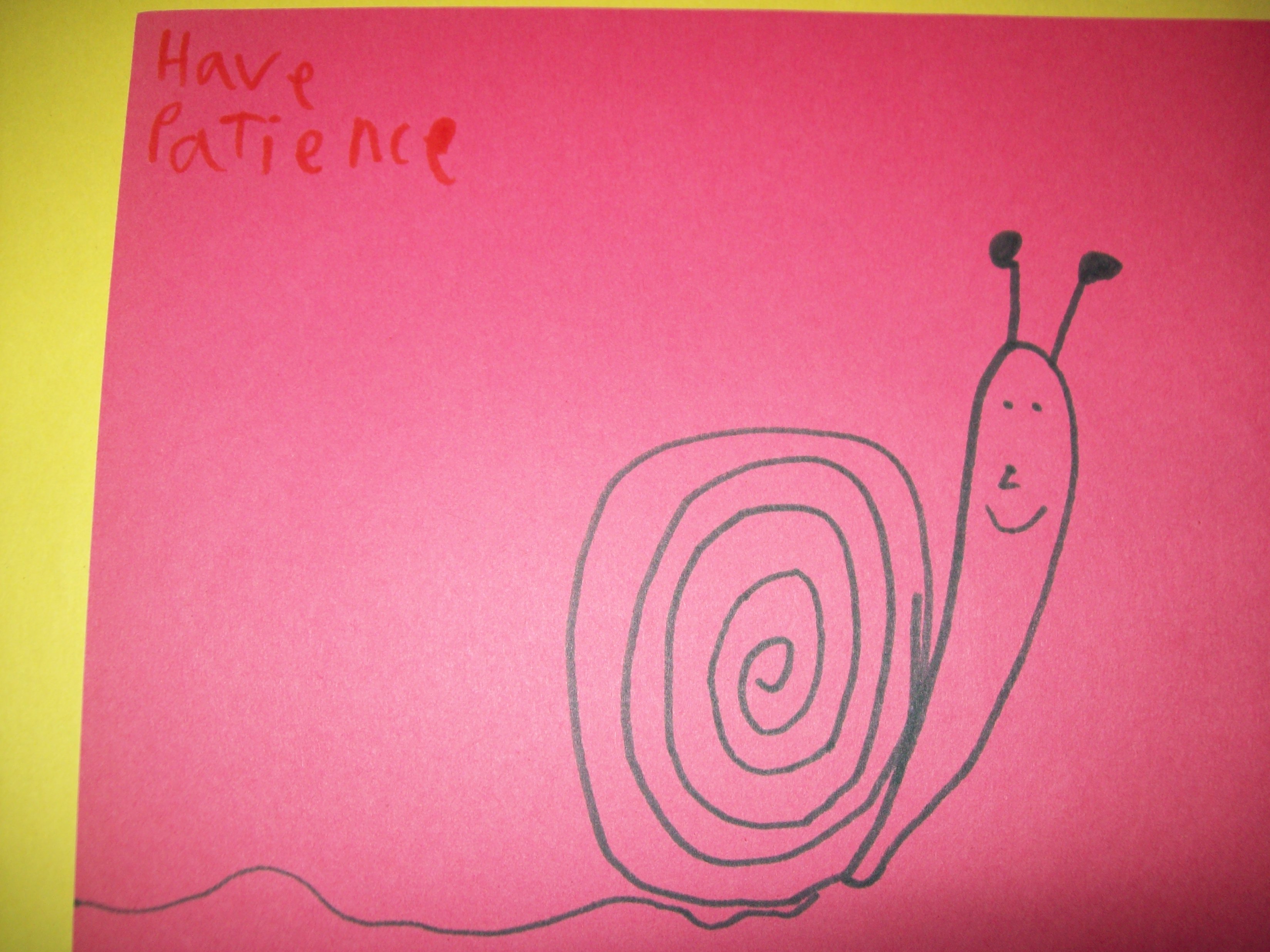
Patience. I need it—badly, sometimes. And when my (frequent) advice on practicing it is handed back to me, it suddenly seems not quite as easy as all that.

But meanwhile . . .

J is neat and organized, but IImage? Not so much. The state of the house usually reflects my habits.

An hour has passed since I told Sonny that I’d play Connect Four with him in a few minutes.

Occasionally Ace confesses that it upsets him when I raise my voice, and I promise to try not to do that anymore. But I keep doing it.

The bulletin board that Sonny and Ace are waiting to have hung on their bedroom has been leaning against the wall for about three weeks.

I have put off responding to a certain e-mail.

My resolution to be cheerful and lighthearted early as the boys get ready for school has not yet come to complete fruition. (Do cheerfully worded comments count as cheerful if they are delivered through gritted teeth?)

Patience. I demand it of others. Sometimes acknowledging this is my fastest route to offering patience to others.

“Love is patient,” says 1 Corinthians 13, and of course this is true. Why is it so hard to be patient to people we love?

“Patience is a virtue,” says common wisdom, and of course this is true. Why does proving ourselves to Crazed  Finger-Flipping Parking Lot Driver sometimes seem more appealing than virtue?

“Though patience be a tired mare, yet she will plod,” says William Shakespeare, via Nym in Henry V. Why is patience so tired? I don’t know. She’s lazy? She’s overworked? She’s underfed?  What matters is that she plods on regardless.

Patience: may she plod on beside you this week, both coming and going.

Unknown's avatar

Don’t Just Ask

Image

It’s rumored on the Internet that the average four-year-old asks 437 questions per day. I have a four-year-old, and that number seemed low to me, so I decided to count for myself. The other day as we pulled out of the garage, I took note of the time and started counting.

Why do pigs eat slop?

How does coldness turn water into ice?

Can we get an iguana?

Why not?

Does heaven have air?

Do harpoon makers make small harpoons for kids?

What are those red things on top of chickens’ heads and under their chins for?

Why does the word carpet have a car and a pet in it?

Are there bilge ducks, too, or just bilge rats?

Can God see inside and outside buildings at the same time?

How do T. Rex’s tails help them balance?

Thirteen minutes and 27 questions later we had arrived at our destination. I’ll let you do the math on that one, but it’s probably safe to say that at that, yes, he probably asks 437 questions a day.

And he expects an answer—a satisfying one—to each one.  He relentlessly hounds whomever he is questioning until one is delivered. “Well, can you find out? I need to know! Can we ask an expert?”

This little experiment made me wonder: Do adults have as many questions as four-year-olds? For the rest of the day I was keenly aware of my own questions—mostly unvoiced, but questions nonetheless.

Where did I put the field trip permission slip?

Why can I remember the lyrics to the songs from my fourth-grade musical (“It isn’t hot in the furnace, man, that furnace is cool, cool, cool!”) but not where I put the field trip permission slip?

Why don’t Honest Kids drink pouches have a hole for the straw?

Whose turn is it to set the table?

Did the words “Please take your sock off the toilet flusher” really just leave my mouth?

What is a more helpful response to someone’s crisis than “Let me know if I can do anything”?

How can I best help my kids learn gratitude?

Where is the unceasing public outrage for human trafficking?

Why does mercy triumphing over judgment look like? And why does mercy too often unsettle us more than judgment does?

Evidently I have just as many questions as my four-year-old. The difference: he pursues answers even to the trivial ones, and I too seldom pursue answers even to the non-trivial ones. They are transitory, too quickly fading away as I turn my attention to less important matters.

That’s not good.

What important questions do you have?

Let’s go find some answers.

Unknown's avatar

Why I Read to My Kids

006

I recently had a conversation with a friend about whether it’s possible to read to one’s kids too much. Is reading several (sometimes many) books to them per day too indulgent? Is this too neglectful of, for example, the laundry festering in piles in the basement or the weeds in the garden?

Everyone knows the advantages of reading to children. Reading promotes a larger vocabulary. Reading encourages listening skills. Reading expands knowledge. Reading raises academic performance. And these are all reasons that I read to Sonny and Ace. But academic benefits aren’t the only reasons for my doing this (if they were, I’d give equal times to math games, which is decidedly not the case).

My friend mentioned that she reads to her four kids so often because it’s guaranteed to get them to stop talking all at once and all the time. Brilliant. This started me thinking about why I read to my kids.

  • It’s built-in cuddling time. Both Sonny and Ace like to snuggle (as do I), at least occasionally, so why not do so while reading? Curling up together on the couch with a book is cozy and preferable to trying to snuggle while I’m ironing or putting groceries away. (I know because my kids have attempted this.)
  • Kids’ books aren’t just for kids.  As C.S. Lewis observed, “A children’s story that can only be enjoyed by children is not a good children’s story in the slightest.” The Little House books. The Hello Goodbye Window. When I Was Young in the Mountains. Poppleton. Frog and Toad. One Morning in Maine. Chicken Sunday. We All Went on Safari. Charlotte’s Web. What’s not to like?                                                        (Conversely, some children’s books are in fact only enjoyed by children. Really, why does the world need SpongeBob books?  And why do my kids know precisely which library shelf houses these? And am I the only parent who sometimes surreptitiously slides these into the book return slot on the way out of the building, moments after we checked them out?)
  • When the three of us are sitting on the couch reading, nobody is trashing the house. (My husband is a neat freak, so no worries there.)
  • Sometimes it’s irresistibly convenient to hold up book characters as role models. Not often enough to be annoying (I hope), but sometimes it just slips out: “Almanzo stayed outside all day, and it was 40 degrees colder than this, and his mittens weren’t even waterproof like yours! So it’s really not so bad out here, is it? ”
  • My kids are learning that reading is a pleasure, not a chore, and that someone who likes to read should never be bored. Reading definitely soothes them. The other day Sonny said, “I’m feeling nervous about school starting. Can we read?”
  • Books give kids vocabulary to express their emotions and questions. Familiar with Have You Filled a Bucket Today, Sonny and Ace often discuss filling or emptying people’s invisible buckets. (“She said I was getting big. That filled my bucket!” “He yelled at her. I think that emptied her bucket.”) And when we read Badger’s Parting Gifts before their grandpa’s funeral, Ace asked softly, “Is Badger coming back?” (It broke my heart to say no, because I knew what he was really asking.)
  • Reading gives the kids more folks to relate to. Wemberly worried about starting school, too.  Wilbur doesn’t want to go to the dentist, either. When I commented to Ace about his love of drawing, he nodded and explained, “I am like Tommy.”
  • If I read to my kids, then I did something right that day. Maybe the kids watched a little too much TV. Maybe my to-do list (written with such optimism . . . two days ago) remains untouched. That three-hour chunk of time when I was going accomplish something was eaten up by a car emergency. Maybe I pretty much feel like a failure today. Well, I’m going to read to my kids now, so take that, unproductive Thursday.

I just asked my kids why they like to read together. Sonny: “I like to learn more about soccer and hear what Henry and Mudge are doing, because they are funny.” Ace: “When we read it is quiet in the house.”

That’s good enough for me.

Unknown's avatar

The World Needs More Artists

“Every child is an artist; the problem is staying an artist when you grow up.” – Pablo Picasso

Kids love to be artists. For a kid, creating something is about the process, not the product, even though Pinterest, with its showcase of perfect products perfectly photographed, would have us think otherwise. And, in fact, the siren song of my “Crafts with Kids” Pinterest board has lured me more than once to transpose the process vs. progress hierarchy, and I park my kids at the kitchen table to fashion, for example, snowy owls out of pinecones and cotton balls.

“Here,” I say enthusiastically. “Start by pulling apart the cotton balls.”

No argument there. Pulling anything apart is fun.

“Now squirt some glue onto these paper plates.”

Squirting glue: also fun.

“Now dip the pieces into the glue—no, not that much; dip it, don’t drag it—and poke it into the spaces in the pinecone.”

Here’s where my plans for Perfect Snowy Owls Made of Pinecones begin to wobble.

“I want to pull apart more cotton balls.”

“I want to squirt more glue.”

“Let’s have a cotton ball snowball fight!”

“Can we put on the googly eyes now? My owl is going to have ten eyes. And I don’t want to glue cotton balls, so he won’t be white and fluffy. He’ll be brown and not fluffy.”

What was I thinking? Making snowy owls was my idea, not theirs; they want to create, not copy. I cobble together a somewhat rumpled snowy owl and let them do their own thing, which they entirely prefer anyway. They paint the cotton balls and glue them on paper. When they run out of cotton balls, they indulge in a few paintings.

Ace paints a volcano: “Here’s the lava flowing, and here are the rocks.”

Sonny: “Is that a tree growing out of the volcano?”

Ace: “Nooo . . . I changed my mind. It’s not a volcano; it’s a dinosaur. That’s its tail.”

And before he finishes, it’s back to being a volcano. Image

Volcano. Dinosaur. Whichever.

Do kids really make those perfect crafts on Pinterest anyway? Ever notice how some of the kids holding up the perfectly crafted item don’t even have paint or marker on their hand or clothing? I’m pretty sure that in some cases—not all, but some—the mom makes a few prototypes of the DYI Stepping Stone or the String Bowl or the Hula Hoop Weaving Loom and then bribes her kid with M&Ms to pose with the best one for a photo.

(Disclaimer: Following a list of instructions to complete a project and taking pride and satisfaction in the product is a good thing. But when kids want to create, they want to create.)

The Torrance Test is a system to test for creativity. For example, the subjects might be given a short amount of time to turn a series of incomplete line drawings into pictures.  Those who score the highest are not necessarily the best artists; they are the ones whose ideas are the most original and elaborate, the ones whose images tell a story, express emotion, present things from a different angle, and convey a sense of motion.

(Try it out at RaiseCreativeKidz. Find some kids and have them try, too. Make up your own incomplete figures for each other to complete. It’s fun!)

E. Paul Torrance, the creator of this test, wanted to prove that creativity was as important as intelligence—in every field, not just the arts. But researchers who have used this and similar tests have found that elementary school kids score better on the tests than high school kids do. Overall scores have been decreasing since 1990.

This is obviously a problem.

“You can’t use up creativity. The more you use, the more you have.”—Maya Angelou

So go paint a picture, transform an incomplete doodle into a vibrant picture, write a song, make up a story, or invent a secret language.

And have your kids do the same.

The world needs more artists.

Unknown's avatar

Lessons from a Four-Year-Old

My little guy turned four a couple weeks ago—but he would take umbrage at being described as little. Despite his reticence toward strangers, he does not hesitate to correct anyone who has called him “little fella” or the like. “’SCUSE me. I am a BIG boy.” (Later he’ll recount the conversation with disgust: “And that guy thought I was little,”—insulted, yes, but mainly astonished that anyone would make such a gross error in judgment.)

This morning he was drawing at the kitchen table. “Come here, Mommy; I have something to teach you. See?” I went to see. “See? If you make a red thing and then color over it with a blue marker, you get a purple thing.” He carefully ran his already-inky fingers over the purple thing. “Except if you color too much with marker in one place, it gets wet and makes a hole, so you have to be careful.”

I took up the blue and the red markers and crafted a purple blob, sans hole. He nodded, satisfied. “I like to teach people things.”

And Ace has indeed proven to be an effective teacher in his four years.

When, at age 10 months, he piled books in front of a baby gate in order to scale it and the next evening actually started to dissemble another baby gate (yes, really), he showed that with a little effort, one not ever need be fenced in.

When, at age 18 months, he seized my hands and dragged me away from chopping vegetables to laugh and dance with him and Sonny to “If I Had a Hammer” in the hall, he illustrated that the carpe momentum opportunities are far more valuable than whatever it is that they’re interrupting.

When he began to fiercely resist having his teeth brushed, he taught me (or, more accurately, forced me to learn) the art of an effective headlock.

When he is eating something particularly scrumptious (be it tangerine slice, M&M, or sunbutter sandwich) and offers someone else a bite—persistently poking it into his or her mouth at the first sign of resistance—he displays not only generosity but also the art of receiving graciously what another is excited to offer. Even if it’s a smudged M&M.

When he stands at the sliding door patiently watching a chipmunk (whom he always dubs Chippy) eat the animal corn he scattered on the deck, he models the importance of taking delight in the small things.

When, first at age 2, and then 3, and now 4 he insists on wearing his beloved firefighter boots to church, yea, even  with his Easter suit, he teaches the entire congregation that a) fashion is not as important as personal style and b) it’s not the kid’s job to make the mom look like she’s on top of things.

When he retreats from a crowded gathering, explaining, “I need some alone time now,” and then emerges, refreshed, 20 minutes later, he proves that introversion requires no apology.

When he spends five minutes buckling his car seat rather than accepting help, he teaches me the importance of doing for oneself. (And patience. Sitting in the garage for five minutes also teaches me patience. I hope.)

When he rejects part of (okay, most of) his wardrobe because “these clothes are not soft, Mommy!” he demonstrates that life is too short to choose needlessly uncomfortable options.

When he stamps and roars through the house in an uncanny imitation of a lumbering T. Rex, he personifies the delightful power of imagination.

When, mere minutes after I snap at him for some not very good reason,  he creeps up behind me, giggling, to tickle the backs of my knees, he challenges me to be a better forgiver-and-forgetter, like him.

And finally, when he bravely advises strangers that he is not little, he shouts to the world that nobody ever has the right to make another person feel small. Ever.

Happy birthday, big guy.